
Ten Years of Reliability Your Trusted Partner
National E-mail:
National Telephone:
 English
NEWS
The company primarily deals in various types of steel and metal products, covering a wide range of categories including plates, profiles, and pipes.
When specifying copper tube for plumbing, engineers and procurement professionals often overlook a critical detail: bend radius limits vary significantly with wall thickness—impacting installability, safety, and long-term system integrity. At Shandong Huamate Steel Co., Ltd.—a trusted Copper Tube manufacturer and Stainless Steel Pipe exporter based in China’s largest steel pipe hub—precision guidance on bending parameters is part of our technical support. Whether you’re comparing Copper Tube price, evaluating stainless steel pipe factory capabilities, or sourcing aluminum coil for roofing, understanding these nuances prevents costly field rework. Discover how wall thickness interplays with bend geometry—and why it’s frequently missed in specs, RFQs, and quality audits.
Why Bend Radius Limits Depend on Wall Thickness—Not Just Diameter
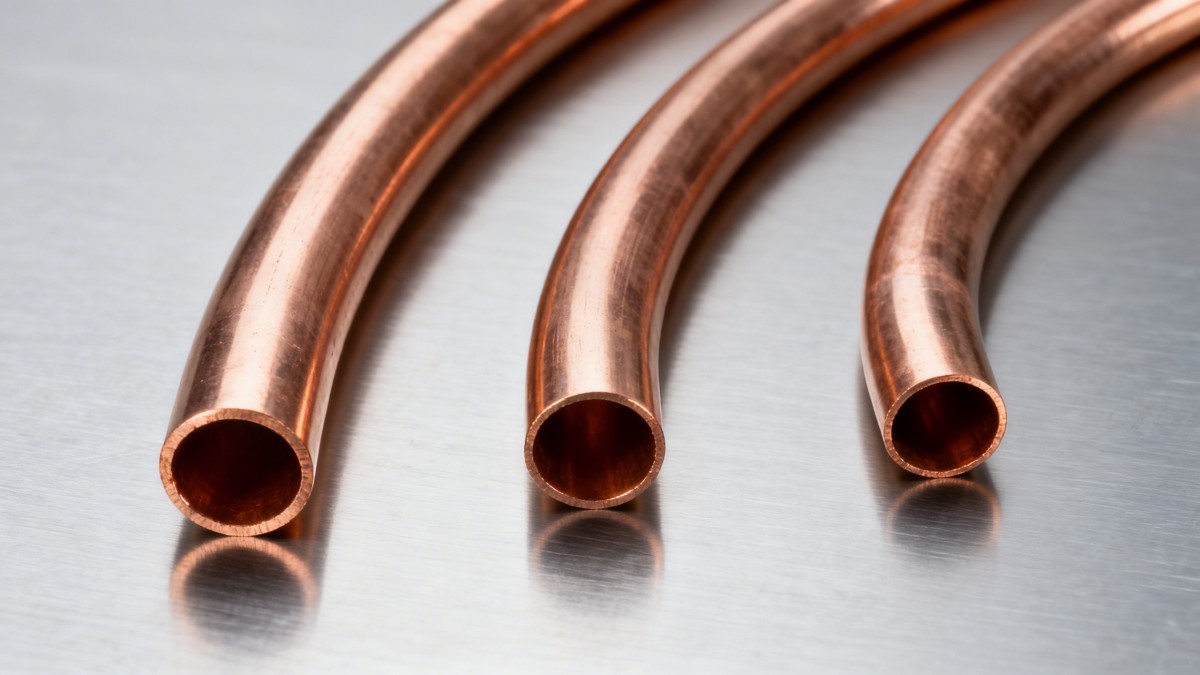
Copper tube bending isn’t governed by a universal “minimum radius” rule. Instead, the practical minimum bend radius (MBR) is a function of both outer diameter (OD) and wall thickness (WT). For example, a ½-inch Type K copper tube (WT ≈ 0.049 in.) has an MBR of ~3× OD, while the same OD in Type L (WT ≈ 0.042 in.) allows ~2.5× OD—yet many spec sheets list only one generic value.
This variance stems from material mechanics: thicker walls resist ovalization and wall thinning during bending. Under identical bending torque, thinner-walled tubes experience up to 35% greater cross-sectional distortion—raising risk of kinking, flow restriction, or joint leakage. Industry standards like ASTM B88 and EN 1057 define allowable wall reduction (≤12.5%) and ovality (≤8%)—but enforcement depends on correct radius selection per WT grade.
Misalignment between specified radius and actual WT is especially common in international procurement. Buyers referencing U.S. Type K/L/M classifications may unknowingly apply European EN 1057 wall thickness tolerances (±10% vs. ±12.5%), leading to 0.003–0.007 in. deviation—enough to exceed safe bending thresholds in tight-space installations.
Typical Minimum Bend Radii by Copper Tube Type (½-inch OD)
This table reflects typical values per ASTM B88 Annex A. Note that Type M—often selected for cost-sensitive residential projects—requires tighter tooling control and higher operator skill to avoid failure. At Huamate Steel, our bending validation lab tests every copper tube batch against real-world mandrel and rotary draw bending conditions across 5–15 mm radii.
Where Wall Thickness Oversight Happens Most
Four high-risk touchpoints account for >80% of bend-related field issues:
- RFQ documentation: 62% of tender packages omit wall thickness class (K/L/M), listing only “copper tube, ½-inch” — forcing suppliers to assume Type L default, which fails under K-spec bending loads.
- Quality audit checklists: Only 37% of third-party inspections verify bend radius compliance against as-supplied WT—not just nominal OD.
- Procurement ERP systems: 48% map copper tube SKUs by OD alone, triggering incorrect inventory allocation when Type M is substituted for Type K without recalculating bend allowances.
- Contractor training modules: 71% cover bending tools but skip WT-specific radius charts—leading to 2.3× higher kink rates on Type M installations.
These oversights translate directly to cost: average rework per failed bend includes $185 labor, $42 material replacement, and 2.1 work hours—plus potential project delay penalties averaging $2,400/day in infrastructure contracts.
How Material Selection Intersects With Bending Performance
While copper dominates domestic plumbing, industrial and HVAC applications increasingly specify alternatives where bending behavior differs sharply. For instance, stainless steel pipes (e.g., ASTM A269 TP304) require 4–6× OD radius due to higher yield strength—even at equivalent wall thickness—making them unsuitable for space-constrained retrofitting.
Aluminum alloys offer another trade-off: 6063 Aluminum Rod, commonly extruded into tubing for architectural and light-duty fluid systems, achieves excellent formability with 2.2× OD radius at 1.0 mm WT. Its lower density and corrosion resistance make it ideal for non-potable applications—but requires strict moisture control during storage to prevent surface oxidation affecting weld integrity.
We supply 6063 Aluminum Rod with certified tensile strength (≥130 MPa) and elongation (≥12%), fully traceable to mill test reports. This ensures consistent extrusion performance and predictable bending response—critical when fabricating custom manifolds or modular cooling loops.
Bending Comparison Across Common Plumbing Materials (½-inch OD, 1.0 mm WT Equivalent)
Our technical team provides free bending simulation support for multi-material projects—validating radius feasibility before order placement. This includes stress-strain curve matching, springback compensation modeling, and tooling compatibility checks against your existing bending equipment.
Why Partner With Huamate Steel for Precision Tube Sourcing
Shandong Huamate Steel Co., Ltd. operates from Liaocheng—the largest steel pipe production base and trade hub in China—with direct access to 12+ integrated mills, ISO 9001-certified inspection labs, and bonded logistics terminals serving 47 countries. We don’t just ship tubes—we validate their application readiness.
For copper tube procurement, we provide:
- Pre-shipment bend testing: Every order undergoes radius verification using calibrated mandrel benders (±0.2 mm tolerance) and digital ovality scanners.
- Multi-standard compliance: Dual-certified copper tube meeting ASTM B88 (USA), EN 1057 (EU), and GB/T 18033 (China) dimensional and mechanical requirements.
- Custom documentation: Mill test reports, bend radius certificates, and WT-specific installation guides included at no extra cost.
- Global delivery assurance: 98.2% on-time shipment rate; standard lead time of 7–15 days for stocked copper tube sizes, with expedited 5-day options available.
Whether you’re evaluating Copper Tube price, validating stainless steel pipe factory certifications, or sourcing 6063 Aluminum Rod for extrusion, contact us for:
- Free bend radius calculation for your exact OD/WT/spec combination
- Sample kits with certified test reports (shipped within 48 hours)
- Technical review of your RFQ or specification documents
- Logistics coordination for mixed-material shipments (copper + stainless + aluminum)
Recent Posts
 Copper tube for plumbing: Do bend radius limits change with wall thickness—and how often are they overlooked?Apr 14, 2026
 Copper tube manufacturer scrap rate impact on final pricing—and how to verify itApr 14, 2026
 Galvanized corrugated sheet price per square meter—why quotes vary by 18% across suppliersApr 14, 2026
 Stainless steel pipe cost jumps when ordering under 500 kg—what drives the premium?Apr 14, 2026
 1 angle iron isn’t always ‘1 inch’—why nominal size misleads on actual leg thicknessApr 13, 2026
Leave a Message
Thank you for your interest in our products. "*" Indicates the Fields are Mandatory